Why Indian IT Companies Are Profitable but Hiring Less: A Data-Backed Look
1. The Pyramid Y2K Built, and Why AI Is Finally Testing It
A relative of mine joined Infosys in 2007. Engineering degree, campus placement, the whole familiar script — and for the fifteen years after that, his career followed a shape that basically every Indian IT engineer of that generation would recognize. Join as a fresher, get staffed on a maintenance project nobody's excited about, put in your years, get promoted into a team lead role, maybe make it to architect if you're good and lucky. It was a predictable machine. It employed literally millions of people. And for the first time in its history, that machine is now profitable and shrinking at the same time, which is a strange enough combination that I wanted to actually understand why, instead of just reacting to headlines about it.
So this is a case study, not a panic piece. I went and checked the actual numbers instead of trusting whatever version of the story shows up in my feed, and the real picture is narrower and more interesting than "AI is killing Indian IT jobs."
2. How a Y2K Accounting Shortcut Built an Entire Industry
To understand why the current squeeze is happening, you have to go back to why the industry exists at all, and the origin story is a genuinely good one.
In the 1960s and 70s, computer memory was absurdly expensive — expensive enough that programmers routinely stored years as two digits instead of four, just to save space. "1978" became "78." It was a completely reasonable engineering trade-off at the time. Nobody involved expected those systems to still be running twenty years later, but a lot of them were, quietly handling banking, aviation, and government infrastructure well into the 1990s.
As 1999 turned into 2000 approached, the industry realized the two-digit shortcut was about to become a serious problem: systems reading "00" might interpret it as 1900, not 2000, with genuinely unpredictable consequences for interest calculations, scheduling systems, and anything else date-dependent. Fixing it meant manually reading and correcting millions of lines of old code — unglamorous, extremely high-volume work, at a moment when American engineering talent was busy chasing dot-com jobs instead. The US was short-staffed enough that the Clinton administration publicly appealed to retired programmers to come back to work.
That gap is where Indian IT companies — Infosys, TCS, Wipro, Tech Mahindra — stepped in. What they were offering wasn't cutting-edge engineering. It was a large, English-trained, technically competent workforce willing to do methodical, high-volume work at a fraction of US labor costs. A US contractor might bill $60–70 an hour for that work; Indian firms could deliver the same output around $27–30 an hour. Everyone in that arrangement came out ahead — clients saved money, Indian firms built billion-dollar businesses, and a generation of Indian engineers and their families moved up economically in a way that reshaped entire cities. Infosys alone reportedly did about $100 million in revenue in 1999.
The part worth sitting with is what the business model actually was. It wasn't intellectual property, or a product, or a patent. It was time, sold at scale. And that detail matters more than it sounds like it should, because it's the exact thing that's under pressure right now.
"The business model wasn't intellectual property, or a product, or a patent. It was time, sold at scale."
3. A Business Built on Billing for People, Not for Output
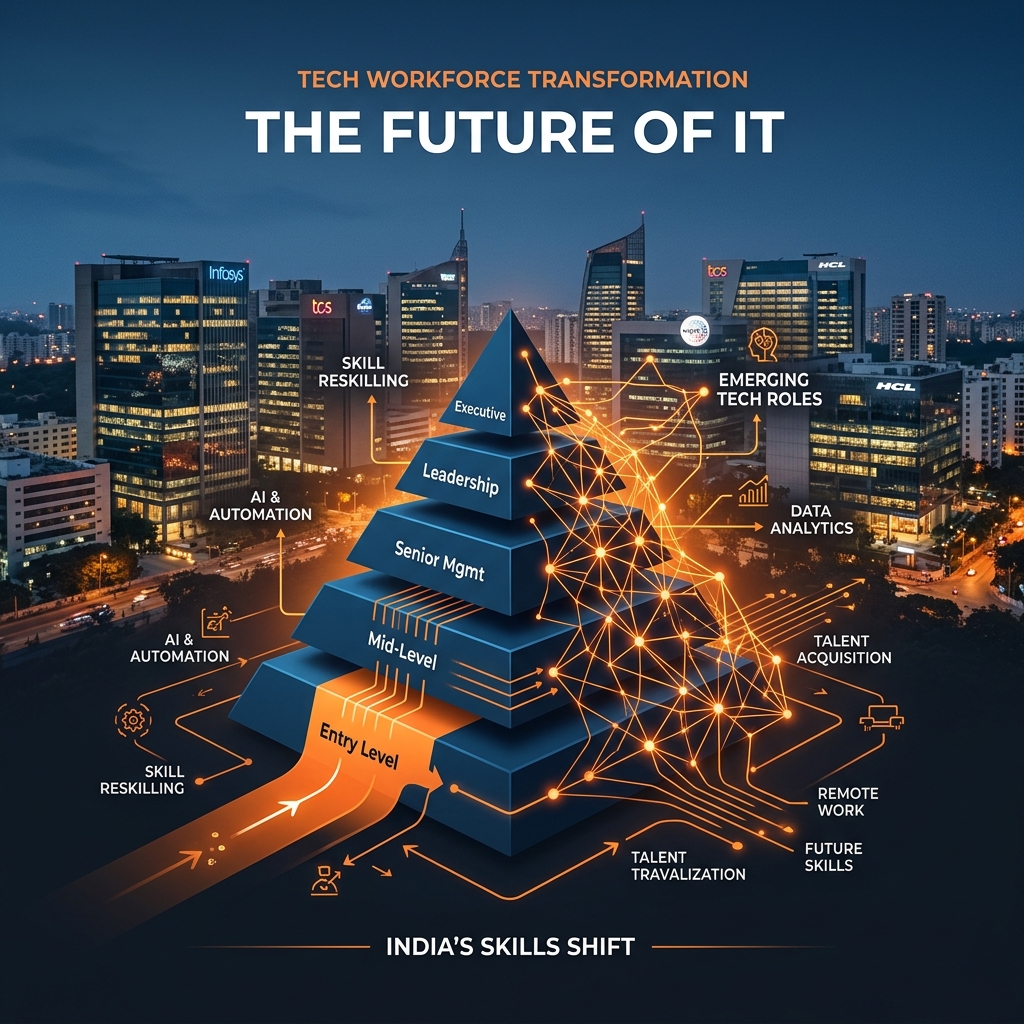
After Y2K passed without the world ending, these companies didn't go away — they had thousands of trained engineers, established relationships with major Western corporations, and a working formula. So they scaled it into the structure most of us associate with Indian IT today: a wide base of freshers doing testing, maintenance, and boilerplate work, a middle layer of team leads managing that base, and a narrow top of architects and client-facing leadership making the actual judgment calls.
The commercial logic underneath that pyramid is simple and, frankly, a little brutal once you see it clearly: contracts are typically structured as people × hours × rate. A fresher costs the company relatively little and gets billed to the client at a healthy markup. Because the base of the pyramid is enormous, that margin compounds into serious profit. It's an efficient, scalable business model — as long as the client is willing to keep paying for headcount.
Which is the exact assumption that AI is now quietly breaking.
4. Checking the Numbers Instead of Trusting the Headline
Here's where I wanted to actually verify things rather than repeat a claim.
Infosys reported AI-related revenue at 8.2% of its total in its most recent quarter, up from 5.5% the quarter before — genuinely fast growth. On the same earnings call, the company narrowed its FY27 revenue growth guidance to 1.5–3%, down from a prior range that topped out at 3.5%, citing softer client volumes, a terminated client program, and pricing pressure in parts of Europe. Both things are true simultaneously: the AI business is real and growing, and the core outsourcing business is under real strain. That's not a contradiction — it's the whole story in miniature.
TCS announced plans in mid-2025 to cut about 12,200 roles — roughly 2% of its global workforce — mostly at mid and senior levels. By the time the exercise wrapped up, actual exits landed closer to 8,000, at a restructuring cost of about ₹1,388 crore. Here's the detail that gets left out of the more dramatic retellings: TCS's CEO, K. Krithivasan, has explicitly said the cuts weren't driven by AI replacing people, but by skill mismatches — employees whose specific expertise no longer matched what the company needed, and who couldn't be redeployed. That's a real distinction. "AI made us more efficient so we don't need as many people" and "we have a structural skills problem unrelated to AI" are different explanations for the same headline number, and it's worth not collapsing them into one just because AI is the more dramatic story.
Entry-level hiring genuinely has taken a hit. Xpheno's Active Tech Jobs Outlook put active tech openings in India at a 28-month low of roughly 93,000 in June 2026, with entry-level roles (under two years' experience) down 44% year-on-year to about 10,000 openings, and senior-level roles down 67%. That's a real, sharp contraction concentrated at both ends of the experience curve.
But — and this is the part that got flattened in the version of this story I first came across — that's not the same as "the Indian tech job market is collapsing." Naukri's own JobSpeak index for the same month showed overall white-collar hiring in India up 6% year-on-year, with AI/ML roles specifically up 25%. IT hiring overall was down, but only about 3%, not the freefall the entry-level number alone suggests. What's actually happening looks less like "AI is destroying Indian tech jobs" and more like a barbell: contraction concentrated at the very bottom and very top of the experience ladder, with steady or growing demand for AI-specific and mid-career skills in between.
5. Why "Just Use AI to Be More Productive" Doesn't Save the Business Model
There's an obvious rebuttal to all of this: give your engineers AI tools, and they'll simply get more done per hour, so nobody needs to lose their job. That's true as far as it goes, but it runs straight into the people × hours × rate structure I mentioned earlier.
If an IT services firm makes its engineers 30% faster, and its clients find out, the natural next move for the client is to ask why they're still being billed for the same headcount. Efficiency gained under a time-based billing model doesn't automatically become profit for the vendor — it becomes leverage for the client to negotiate the contract down. The industry has started calling this "AI deflation," and it's a genuinely different problem from the usual cost-cutting cycle, because it's structural rather than cyclical. It doesn't fully apply to a company like Microsoft, which sells software at a fixed price regardless of how efficiently it was built — efficiency gains there flow straight to margin. It applies specifically to firms whose entire commercial model is priced in human hours, which describes most of the traditional Indian IT services industry almost exactly.
6. What Actually Seems Safe, Based on What AI Still Can't Do
None of this means the judgment-heavy end of the pyramid is at risk in the same way. AI is not, at least right now, particularly good at sitting across the table from a nervous client executive and figuring out what they actually need versus what they're saying. It's not good at owning the political trade-offs between six technically defensible architecture choices, or taking accountability when a production system fails at 3 a.m. and someone has to make a fast, high-stakes call. That's the top of the pyramid, and Bain's research backs up that this is where the real opportunity sits: the firm projects India's AI-related job openings could exceed 2.3 million by 2027, against an expected talent pool of only around 1.2 million — a gap, not a surplus.
So the honest version of this story isn't "AI is coming for programmers." It's narrower and, I think, more useful: AI is extremely good at exactly the kind of repetitive, well-specified, high-volume work that built the wide base of the Indian IT pyramid — testing, boilerplate, maintenance, translation between systems, documentation — and it's still weak at the ambiguous, judgment-heavy, relationship-dependent work at the top. India built the widest base of that pyramid in the world. That's precisely the part now under the most pressure, while the top and the AI-adjacent middle are, if anything, short on people.
7. What I'd Actually Tell Someone Early in Their Career Right Now
If I were advising the version of my relative who joined Infosys in 2007, but starting out today, it wouldn't be "avoid IT" — the data doesn't support that, and there's a real shortage of qualified AI talent sitting right next to the shrinking entry-level numbers. It would be closer to this: build enough underlying understanding that you're not dependent on AI tools to compensate for gaps in your knowledge — use them because you understand what they're doing, not as a substitute for learning it. Go after real depth in AI tooling rather than certificates that look good on a resume but don't reflect actual capability. And take communication seriously as a skill in its own right, because the part of this industry that isn't shrinking is the part where someone has to sit across from a client about to commit ₹100 crore and be trusted enough to have that conversation. Engineering colleges mostly don't teach that last part, which is probably worth fixing on its own, separate from anything AI is doing.